Marcia's Fast Free Course in Media Publicity
The article below is the fifth
of seven articles that give you a quick,
well-rounded introduction to the fundamentals of
getting media coverage for yourself, your book,
your business or your cause. After reading
this piece, click on "NEXT" to
read the next article in the series. START
AT THE BEGINNING.
Anatomy of a News Release
by Marcia Yudkin
|
Not sure how to write and structure an effective
news release (also called a press
release or media release)?
Here are basic and advanced tips on this document's
seven essential components.
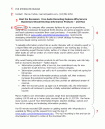
Click on the graphic
to the right to see exactly where and
how they show up in a sample release. |
 |
|
Sample
Release
(Click It to Enlarge It)
|
1. For immediate release.
This phrase indicates the lack of any embargo on the news in a release. Anyone in the media is free to pick up the story at once. "For release June 30" would mean that the news shouldn't be disseminated before that date. This applies mainly to award results or official company announcements scheduled for a certain day.
|
2. Contact information.
Who is designated to handle inquiries from reporters, editors and producers? Remember, media people work on deadline. Make sure not only that your contact person is well-informed about the subject of the release but that you've provided adequate contact mechanisms so that a media call or
email receives a reply within a few hours.
Cell phone numbers, business and personal
email addresses or just frequently checked email
can make the difference between media coverage and a missed opportunity because a Friday afternoon phone call wasn't returned till the deadline passed.
|
 |
You can place the
contact information up top or at the end.
Its location doesn't matter as much as it being
easy to find.
3. Headline. Forget about cute, tantalizing headlines. Instead, try to get as much of your "Who, What, When, Where and Why" into the headline as possible. Often the headline determines whether or not someone will look at the whole release, and if it doesn't seem relevant to the media person's beat, they'll skip it for a headline that does. Long headlines are fine. For example, instead of "A Stitch in Thyme..." (what in the world is that about?), write "Gardening Site YourGarden.Net Offers New Early-Blooming Spice Plants for Northern Climates."
4. Dateline.
A long-standing convention in the news
business, the dateline indicates the source
location of a news story - where the event took
place. In a release, you'd normally place the
city where your company is headquartered in the
dateline.
|
Get to the Point
Quickly and Powerfully
Eliminate wordiness! Learn how to get your point across in one page or how to satisfy a strict word count for magazine or newsletter editors. Discover how to identify and cut repetition, slash excess verbiage, make your point fast and convey a wealth of facts in a small space. My longwinded clients asked for this!
Become more
concise. |
5. Lead paragraph.
Include all the basic details about your news offering in the first paragraph, written in a lively style. Test it: reading only the first paragraph, would someone get the basic point of the release? Would the reader comprehend who would benefit from your news item and why? Would someone in your target market want to read on and learn more? If not, rewrite your lead paragraph until it both entertains and informs.
6. Body of the release.
Develop the rationale, features and benefits of your news angle in the next few paragraphs. It's customary to include at least one quote from a company spokesperson, an industry figure or client to liven up the release. Both here and throughout the release, stay away from a sales-y tone using "you" in favor of third-person journalistic objectivity. Head off the #1 complaint of newspaper editors about the releases they receive: sounds like advertising.
7. Last paragraph.
Here, place ordering details about your product or service as well as where on the
web someone should go for further information. Always include the complete price, including shipping and handling, so that if the release is printed word for word, someone knows the total amount of their purchase and can send you an
international money order from, say, Botswana. Remember, the Internet is a global news network!
Copyright 2009 Marcia Yudkin.
All rights reserved. NEXT
ARTICLE.
Online Courses Related to Publicity
Deep Publicity
The Press Release Makeover Course
Marketing for Introverts
Create a Practical Marketing and Publicity Plan |